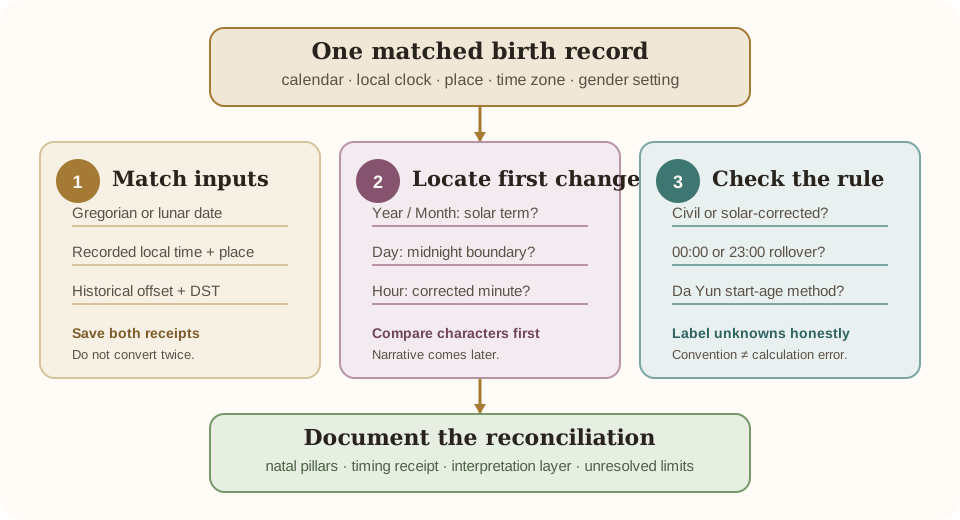
Two Bazi calculators can give different charts for the same birth record because they may be reading a different input, applying a different calendar convention, or presenting the same calculated characters through a different interpretation layer. The useful question is not which result feels more familiar. First match the record, then identify the first changed pillar, then compare the disclosed rule that could produce it. A result with a visible receipt and reproducible inputs is easier to assess than an unexplained label.
This guide is a reconciliation workflow. It separates a school convention (a documented choice between accepted approaches), a calculational error (a mismatch with the tool's own stated input or rule), and an interpretation difference (the characters agree but the explanation differs). The distinctions matter: a different Ten Gods translation may be editorial, while different original stems or branches need an input or calculation check.
1. Match the birth record before comparing charts
Copy the original record into a small comparison sheet. Record whether the date is Gregorian or lunar, the written clock time and whether it is rounded, the birthplace and its coordinates, the historical time zone and daylight-saving status, the gender setting if the tool uses it, and whether the source is a birth certificate, a family recollection, or an approximate memory. A city name alone can resolve to the wrong place; a country or coordinate makes the comparison safer.
- Enter the same calendar: do not let one tool treat a lunar date as Gregorian, or silently convert a Gregorian date twice.
- Keep the same local clock reading. Do not manually turn a London clock into UTC or Beijing time unless the calculator explicitly asks for that representation.
- Use the same location, longitude, IANA time zone, and historical DST setting. Modern offset tables do not automatically describe an older birth record.
- Save each tool's calculation receipt, including corrected time, solar term, day-boundary rule, and any option labelled true solar time, local mean time, or standard time.
2. Find the first changed character
Compare the Year, Month, Day, and Hour pillars as characters before reading an element summary or a forecast. The first difference narrows the search. Year and Month changes often point to a solar-term boundary or a year convention; Day changes can follow a corrected timestamp crossing midnight; Hour changes often sit near a two-hour branch boundary. If all eight characters match, the disagreement may be hidden-stem weighting, Ten Gods naming, Da Yun timing, or interpretation rather than a natal-chart calculation difference.
| What changed? | Likely source | Next check |
|---|---|---|
| Gregorian/lunar date or Year Pillar | Calendar input or the Bazi year boundary | Calendar type; Lichun versus Lunar New Year. See the zodiac boundary guide. |
| Month Pillar | Solar-term Jie boundary or a month-label convention | Exact Jie instant and time zone; do not equate a lunar month. |
| Day pillar near midnight | Local clock versus corrected time, or a Zi/day boundary convention | Corrected timestamp; 00:00 versus 23:00 rule. |
| Hour pillar only | Two-hour branch boundary or true-solar correction | Longitude, EoT, DST, and final corrected minute. |
| Da Yun start or age | Reference Jie, direction, interval rounding, or start-age conversion method | Jie, interval, formula, and exact start time. See the Da Yun guide. |
| Summary or English labels | Hidden-stem weights, translation, or interpretation | Original characters; Day Master and Ten Gods mapping. |
3. A controlled same-input example
Here is one reproducible comparison using the same synthetic record: 12 February 1990 at 01:10 in London, Europe/London, longitude -0.1276°, with UTC offset 0 and DST offset 0. A clock-only calculation keeps the local reading at 01:10 and returns the Hour Pillar 癸丑 (Gui-Chou). The current BaziCalculator.ai engine applies longitude correction of -0.51 minutes and Equation of Time of -14.22 minutes, for -14.73 minutes total. The corrected time is 00:55 and the Hour Pillar becomes 壬子 (Ren-Zi). The Year, Month, and Day pillars remain 庚午 戊寅 戊申 in both runs.
Swipe to inspect the diagram · Tap to open full size
| Same input | Clock-only run | Corrected-time run |
|---|---|---|
| 1990-02-12 01:10 · Europe/London · -0.1276° | 01:10 · Hour 癸丑 (Chou) | 00:55 · Hour 壬子 (Zi) |
| Correction details | No location correction | Longitude -0.51 min · EoT -14.22 min · total -14.73 min |
| Four Pillars | 庚午 戊寅 戊申 癸丑 | 庚午 戊寅 戊申 壬子 |
4. Separate conventions from mistakes
First separate an input representation from a convention. Gregorian versus lunar is an input choice that must be converted once; local clock, UTC, or Beijing time is a representation that must carry the correct offset. Historical time-zone and DST data are facts about the recorded place and date, though older coverage can be incomplete. After those are matched, a tool may still choose local civil time or solar-corrected time, assign the Bazi Year at Lichun while a popular zodiac label uses Lunar New Year, select the Month by solar-term Jie boundaries, or leave the clock untouched. It may also use a corrected-time Zi/day boundary. Those conventions should be disclosed and held constant when you compare results.
A calculation error is different: the tool claims to use the recorded local time but silently interprets it in another zone; it shows a correction that does not match its own final timestamp; it selects a solar term inconsistent with the displayed time; it applies a 23:00 rollover while claiming a 00:00 rule; or the same saved input changes after a refresh without a documented data update. Capture the receipt and ask for a reproducible explanation. Do not call an undisclosed implementation a school tradition simply because its output is different.
Interpretation begins after the natal characters are fixed. Different English names for the same Ten Gods, different hidden-stem weights, or a different way of describing element balance can produce different summaries while leaving the original stems and branches unchanged. If the original Ten Gods relationship itself differs, check the Day Master, polarity, and mapping rule before treating it as interpretation. Da Yun is another layer: its starting age and current presentation may differ even when the natal chart matches. Compare natal pillars, Da Yun receipt, and explanatory labels as separate objects.
5. What if the birth time is unknown or rounded?
An unknown birth time cannot select a precise Hour Pillar. A rounded time can also sit on the wrong side of a two-hour branch boundary, a corrected midnight, or a solar-term boundary. This site's current sect 2 rule rolls the Day Pillar at 00:00 of the corrected timestamp; another school may use a 23:00 Zi-hour rollover, so the choice must be named rather than inferred. If the Day Pillar is close to corrected midnight, treat it as provisional until the record is improved. A responsible calculator should say which timing layers it withholds rather than filling the gap with a confident character or a precise Da Yun age.
- Keep an uncertainty note beside the record: exact, approximate, family recollection, or unknown.
- Run a narrow time range around the remembered time and mark every pillar that changes; do not choose the chart that produces the preferred story.
- For older records, preserve the place and date as recorded while checking whether the historical time zone is actually known. Pre-1970 time-zone data can be incomplete.
6. How to decide which chart you can use
Choose the chart whose inputs and conventions you can inspect and reproduce for the purpose at hand. That is a defensible trust rule; it is not a claim that one school has settled every traditional question. Keep both outputs when the convention is genuinely unresolved, label the changed pillar, and explain what interpretations depend on it.
- Save the original record, both receipts, and the exact characters that differ. Redact private birth details before sharing a question publicly.
- Ask each provider for the calendar type, local-time conversion, historical offset/DST, coordinates, true-solar formula, solar-term boundary, Zi/day boundary, and Da Yun calculation method.
- Recalculate one controlled case with the same values. If the first difference cannot be reproduced or explained, report it as unresolved rather than selecting by preference.
- Keep natal pillars, Da Yun timing, and interpretation notes in separate columns so a narrative disagreement does not overwrite a calculation fact.
Ready to compare a chart with its calculation receipt?
Open the free Bazi calculatorEditorial note
Written and reviewed by BaziCalculator.ai Editorial Team. The team checks the explanatory copy and example outputs against the current BaziCalculator.ai chart engine. This organization byline identifies the accountable project role; it does not claim a named practitioner, professional credential, or external endorsement.
Published October 9, 2026 · Last updated October 9, 2026
Methodology and sources
These guides explain the traditional Bazi framework as an educational system, not as a guaranteed prediction or professional advice. When you use the calculator, it converts the supplied birth date and time into the Four Pillars, uses the selected location for time-zone and true-solar-time correction, and then reads the Day Master, element relationships, and Life Chapters in context. Results depend on the birth details and calculation conventions you provide.
- BaziCalculator.ai review process and AI boundaries
- BaziCalculator.ai — True solar time methodology — Site-specific correction inputs, Equation of Time method, historical limits, and reproducible examples.
- BaziCalculator.ai — London calculation benchmark — Pinned same-input engine case for the 1990 London hour-boundary comparison; audit pages are not included in the public sitemap.
- IANA Time Zone Database — Reference for named time zones and historical offset data; older coverage can remain incomplete.
- tyme4ts v1.5.2 — Pinned calendar and solar-term library used by the current web engine; provider behavior remains a site implementation choice.
- Report a calculation, source, example, or translation issue