A birth certificate records civil time: the time shown by clocks under the time-zone and daylight-saving rules in force at that place and date. A Bazi calculator may instead derive the Hour Pillar from local apparent solar time — what a properly constructed and calibrated sundial would indicate at that location and instant. Converting the recorded clock time to that solar reading requires the historical UTC offset, birthplace longitude, and the sun's seasonal variation. Civil and solar time are not always the same minute, or even the same two-hour branch.
That difference is one reason two calculators can return different Hour Pillars from the same recorded birth details. But it is not the only reason: calculators may also use different historical time-zone data, birthplace coordinates, solar-time formulas, or Bazi day-boundary conventions. This page documents the method used by BaziCalculator.ai so the result can be checked rather than taken on trust.
Three Kinds of Time You Should Not Mix Up
| Time concept | What it means | What determines it |
|---|---|---|
| Civil time | The wall-clock time written on a record. | A government's UTC offset and daylight-saving rules at that date and place. |
| Local mean solar time | A uniform solar clock based on the birthplace longitude. | Four minutes for each degree of longitude from the reference meridian. |
| Local apparent solar time | The local mean solar time adjusted for the apparent sun's seasonal variation. | Longitude plus the Equation of Time. This is the true solar time used by this site. |
A time-zone label alone is not enough. For example, modern China uses UTC+8 across a wide longitude range, and the civil-time rules in 1990 were not the same as they are today. The calculation therefore needs the birthplace, local date, and local recorded time together.
TRUE SOLAR TIME
From civil time to the Bazi hour · 真太阳时
Keep legal clock time, historical offset, and solar geometry as separate inputs.
- 01
Civil time
Recorded wall-clock time
- 02
UTC offset
Historical legal offset
- 03
Longitude
Distance from the zone meridian
- 04
Equation of Time
Date-specific solar variation
- 05
True solar time
Local apparent solar clock
- 06
Hour branch
The final Bazi time window
Civil time + historical rules + solar geometry → Bazi hour
The historical UTC offset already includes any daylight-saving adjustment; do not apply that term twice.
The Formula Used by This Calculator
This is the sign convention in NOAA's General Solar Position Calculations. It is useful because it accepts the actual UTC offset directly: when a birthplace was observing daylight saving time, there is no need to subtract a second, hand-written “DST hour” later. Doing both would double-count the clock change.
The corrected timestamp is also the input to this site's Da Yun starting-age calculation. That guide shows how historical daylight saving time can change the birth-to-Jie interval and exposes the exact boundary in a calculation receipt.
Step 1: Resolve the Historical UTC Offset
Time zones are political histories, not permanent longitude bands. Governments change offsets, start or stop daylight saving time, and occasionally use unusual increments. The IANA Time Zone Database records these changes for representative locations and is periodically updated when rules change.
The production engine uses an IANA zone name such as America/Chicago or Asia/Shanghai and asks the runtime for the offset that applied to the supplied local date and time. This catches details that a fixed “UTC+8” or “subtract one hour in summer” rule misses. In the regression suite, China is UTC+9 on 15 June 1990 because daylight saving time was in force, while Lord Howe Island supplies a 30-minute — not 60-minute — DST increment in January 2025.
Whether a birth date falls inside a daylight-saving era is one of the first things to check, because one hour is half a branch window. The table distinguishes the rules encoded in the IANA data queried by the engine from archival history: those are not always identical, especially before 1970. Hong Kong's official record comes from the Hong Kong Observatory; Taiwan's 1969 exception is documented by Taiwan Historica but is absent from the current Asia/Taipei rules.
| Birthplace | Daylight-saving eras | Window within each year |
|---|---|---|
| Beijing Time / Asia/Shanghai | 1986–1991 | Mid-April to mid-September; in 1986, 4 May to 14 September |
| Hong Kong | 1941–1976; 1979 | Highly variable: all year in 1942–1945; 30 Dec 1973 to 20 Oct 1974; no DST in 1977–1978 |
| Taiwan | IANA: 1946–1961; 1974–1975; 1979. Archives also document 1969 | Usually spring to autumn; 1969 is not encoded by the current runtime; in 1979, 1 July to 30 September |
Step 2: Correct for Longitude
Relative to the mean sun, 360 degrees corresponds to 24 hours of mean solar time, so one degree of longitude corresponds to exactly four minutes on that scale. This is distinct from Earth's roughly 23-hour-56-minute rotation relative to the stars. A civil time zone assigns one clock to a region, but solar noon still moves continuously with longitude. A city west of its zone's nominal central meridian reaches local solar noon later by the civil clock; a city east of it reaches solar noon earlier.
LONGITUDE CORRECTION
One time zone, different solar noon · 经度修正
UTC+8 shares one clock, but longitude shifts local apparent solar time.
UTC+8 reference
120° E · standard meridian
One civil clock can cover a wide longitude range; solar noon still shifts continuously across it.
Beijing
北京116.4° E
Longitude correction
−14.4 min
Chengdu
成都104.1° E
Longitude correction
−63.6 min
Singapore
新加坡103.8° E
Longitude correction
−64.8 min
Farther west → solar noon arrives later by the civil clock
These are longitude-only comparisons. Historical offsets and the Equation of Time remain separate correction terms.
| Location | Longitude | UTC+8 longitude component | What is not included |
|---|---|---|---|
| Beijing | 116.4°E | (116.4 − 120) × 4 = −14.4 min | DST and Equation of Time |
| Chengdu | 104.1°E | (104.1 − 120) × 4 = −63.6 min | DST and Equation of Time |
| Singapore | 103.8°E | (103.8 − 120) × 4 = −64.8 min | Equation of Time |
| Urumqi | 87.6°E | (87.6 − 120) × 4 = −129.6 min | Clock basis — see the callout below |
Step 3: Add the Equation of Time
Even after longitude is accounted for, apparent solar time does not run at a perfectly uniform rate through the year. Earth's orbital eccentricity and axial tilt cause the apparent sun to cross the local meridian at uneven clock intervals. The Equation of Time (EoT) describes the difference between apparent solar time and mean solar time.
In the NOAA fractional-year approximation used here, a positive value means apparent solar time is ahead of mean solar time; a negative value means it is behind. The curve is roughly −14 to +16 minutes over a representative year. That term is smaller than the longitude correction for many cities, but it can still decide a chart that lies close to a two-hour boundary. The approximation's own error must therefore be included in the boundary uncertainty, not hidden by minute-level rounding.
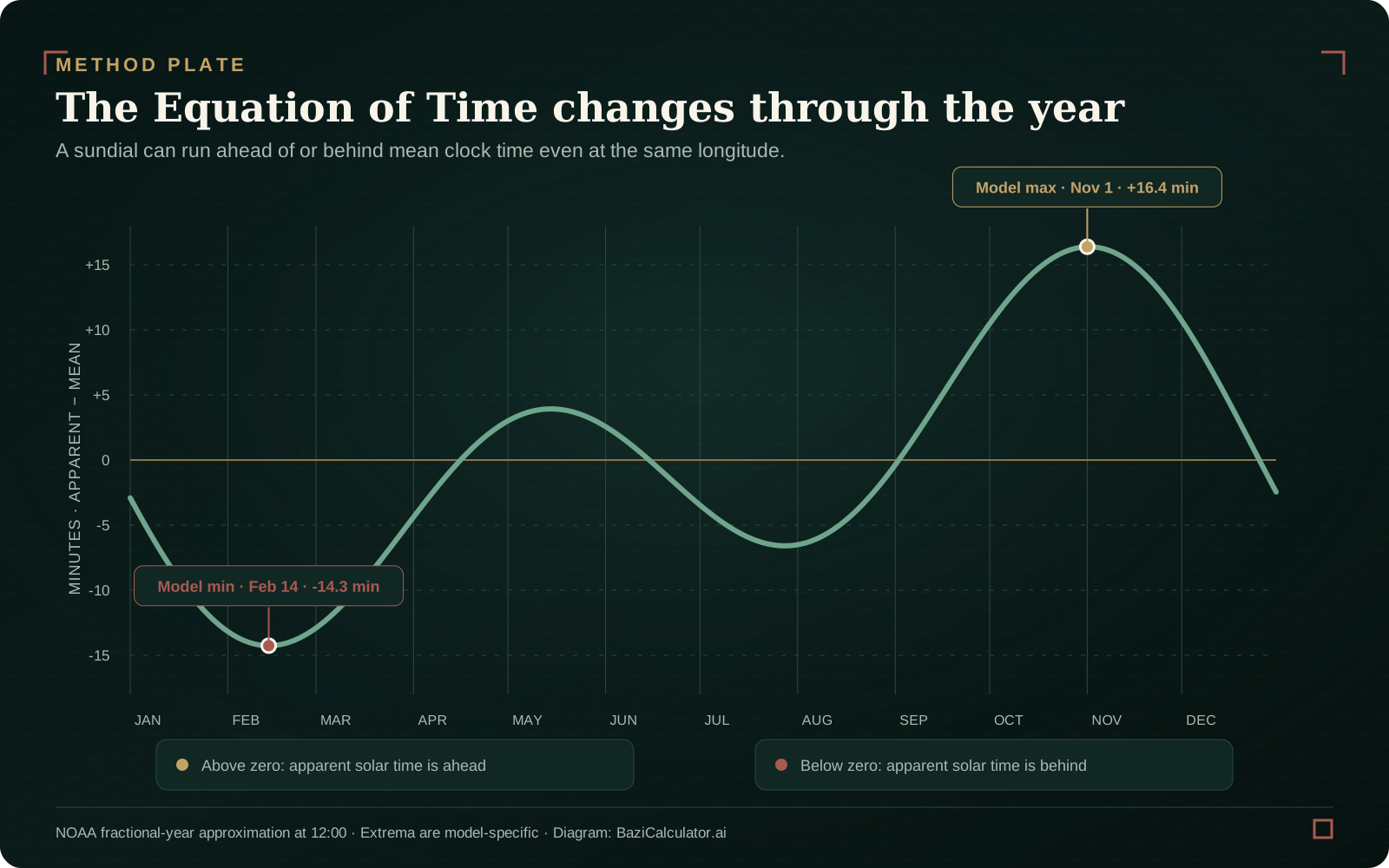
Swipe to inspect the diagram · Tap to open full size
Worked Example: Chicago, 15 June 1990
Suppose a birth record says 12:00 on 15 June 1990 in Chicago, using longitude 87.63°W and the IANA zone America/Chicago. The current production engine returns the following intermediate values:
- The historical offset at that local time is UTC−5. Chicago was observing daylight saving time, 60 minutes ahead of its standard offset.
- Relative to the UTC−6 standard meridian, the longitude component is +9.48 minutes.
- The NOAA Equation of Time for that date and hour is −0.03 minutes in the engine's rounded output.
- The direct NOAA formula gives a total correction of −50.55 minutes.
- Recorded 12:00 therefore becomes 11:09 true solar time after normalization. Under this site's branch windows, that remains the Wu hour (11:00–13:00), but it is only nine minutes from the preceding boundary.
When the Correction Changes the Hour Pillar
The same recorded noon does not produce the same corrected branch everywhere. On 15 June 1990, the regression examples for Beijing and Chengdu both resolve to UTC+9 because China was observing daylight saving time. Their more westerly longitudes then pull local apparent solar time back far enough to cross from the recorded noon's Wu window into the preceding Si window.
HISTORICAL CASE STUDY
One recorded noon, three corrected results · 历史夏令时
The same wall-clock time resolves differently by location and historical offset.
Same recorded moment
15 June 1990 · 12:00 local time
Chicago
芝加哥True solar time
11:09
Wu · 午
Beijing
北京True solar time
10:45
Si · 巳
Chengdu
成都True solar time
09:56
Si · 巳
Location + date + civil-time history all matter
The values are rounded regression examples from the production calculator; they are not interchangeable city defaults.
| Recorded local time | Actual offset | Total correction | True solar time | Branch used here |
|---|---|---|---|---|
| Chicago · 1990-06-15 12:00 | UTC−5 | −50.55 min | 11:09 | Wu · 11:00–13:00 |
| Beijing · 1990-06-15 12:00 | UTC+9 | −74.43 min | 10:45 | Si · 09:00–11:00 |
| Chengdu · 1990-06-15 12:00 | UTC+9 | −123.63 min | 09:56 | Si · 09:00–11:00 |
The Two-Hour Windows Used on This Site
| Branch | True solar time | Branch | True solar time |
|---|---|---|---|
| Zi (子) | 23:00–01:00 | Wu (午) | 11:00–13:00 |
| Chou (丑) | 01:00–03:00 | Wei (未) | 13:00–15:00 |
| Yin (寅) | 03:00–05:00 | Shen (申) | 15:00–17:00 |
| Mao (卯) | 05:00–07:00 | You (酉) | 17:00–19:00 |
| Chen (辰) | 07:00–09:00 | Xu (戌) | 19:00–21:00 |
| Si (巳) | 09:00–11:00 | Hai (亥) | 21:00–23:00 |
A correction matters most near one of these boundaries. If the recorded time is rounded, reconstructed from memory, or written during a repeated DST hour, the mathematical output can be precise while the input remains uncertain. The responsible response is to show that uncertainty — not to present the final branch as more certain than the record allows.
Why Two Bazi Calculators May Still Disagree
- One calculator uses recorded civil time directly while another applies local apparent solar time.
- One uses the correct historical UTC offset while another applies today's offset or a fixed one-hour DST rule.
- The city coordinates differ, or one tool substitutes a regional center for the actual birthplace.
- The Equation of Time formula, sign convention, or leap-year handling differs.
- The tools use different Zi-hour or day-boundary conventions near 23:00 and midnight.
- One tool cuts the Bazi Year Pillar at the Lichun solar term in early February while another reports the popular zodiac from Lunar New Year or uses January 1st. A January 1st boundary can disagree with Lichun for every birth from January 1st until Lichun; a Lunar New Year boundary disagrees during the interval between Lunar New Year and Lichun, whichever comes first (this site labels both legitimate conventions).
- One tool rounds intermediate values before determining the boundary while another preserves full precision.
Compare the receipt before choosing a result
Start with the same recorded details and compare the intermediate values below. A final Hour Pillar alone cannot tell you which input or convention caused the disagreement. This checklist organizes the method explained on this page; it does not certify another calculator's accuracy.
| Check | What to compare |
|---|---|
| Recorded birth details | The same local date, clock time and original record wording; mark an unknown or rounded time rather than treating it as exact. |
| Historical clock rule | The birthplace time-zone name and actual UTC offset on that date. An encoded daylight-saving increment is already in that offset; subtracting it again changes the input twice. |
| Birthplace coordinates | The longitude used for the birthplace, including whether it represents a city center or the recorded location. |
| Solar correction | Whether the tool uses civil, mean solar or apparent solar time; compare the longitude term, Equation of Time sign and corrected timestamp before rounding. |
| Day boundary | The corrected date and stated Zi-hour/Day Pillar convention, especially around 23:00 and midnight. |
| Compare the receipt | Check the complete correction chain and uncertainty, then the Hour and Day Pillars. When a record is ambiguous, compare plausible inputs instead of picking the result you prefer. |
If you would rather inspect the boundary cases than read about them, this site publishes them. Each case shows its synthetic input, the pinned expected facts, the engine version and the convention in play, and every one is recalculated during the build so that a drift stops the release. The public calculation benchmark suite covers historical time zones, true-solar crossings, the Zi-hour and midnight boundaries, unknown birth times and Luck Pillar direction. The London case, for example, crosses an hour boundary on the Equation of Time alone, with the longitude term almost zero.
Limits and Calculation Conventions
- Birth record: a remembered or rounded time can dominate the uncertainty, especially within about 30 minutes of a branch boundary.
- Coordinates: a city-center longitude is appropriate for most users, but it is not the exact delivery-room coordinate. One degree equals about four minutes.
- Historical civil time: IANA notes that pre-1970 local-time history is harder to model comprehensively and may be incomplete for some locations.
- Pre-1949 China: the Central Observatory proposed five zones in 1918, from Kunlun (UTC+5:30) through Longshu (UTC+7) to Changbai (UTC+8:30). The plan initially caught on mainly in UTC+8 coastal areas, was displaced in theory by UTC+7 during the war, and was officially restored with modifications in March 1948; surviving evidence does not establish uniform observance. This calculator does not reconstruct that history. Most Chinese cities use
Asia/Shanghai, which supplies UTC+8 and Shanghai's wartime DST rules, while Xinjiang cities useAsia/Urumqi, an approximate UTC+6 model from 1928. Depending on the place and clock, a five-zone interpretation can differ from a Shanghai-based result by 30, 60, 120, or 150 minutes. Identify the clock represented by the record before trusting a near-boundary Hour or Day Pillar. - Astronomical model: the 1990 daily comparison above found up to about 0.76 minutes between NOAA's fractional-year approximation and USNO ephemeris data. The model is suitable for this calculator's minute-level correction, but a result that close to a branch boundary needs a higher-precision check.
- DST transition: repeated or skipped local times require interpreting the original record, not just applying arithmetic.
- Bazi day boundary: the public calculator's current sect 2 default starts the Zi Hour branch at 23:00 but rolls the Day Pillar at civil midnight. The engine can also calculate sect 1, where 23:00–23:59 belongs to the next Day Pillar; the public form does not currently expose this as a switch.
Regression Matrix
The current test suite imports the production correction function instead of reimplementing the math in a separate test. Each case checks the corrected minute, the resulting branch, and the historical DST increment. The expected display values are:
| Case | Recorded local time | Expected true solar time | What it protects |
|---|---|---|---|
| Chicago | 1990-06-15 12:00 | 11:09 · Wu | US DST + longitude + EoT |
| Beijing | 1990-06-15 12:00 | 10:45 · Si | Historical China DST |
| Chengdu | 1990-06-15 12:00 | 09:56 · Si | Historical DST + large longitude delta |
| Singapore | 1990-06-15 12:00 | 10:55 · Si | Large UTC+8 longitude delta without DST |
| New York | 1990-01-15 12:00 | 11:55 · Wu | Winter standard time + negative EoT |
| London | 1990-02-12 12:00 | 11:45 · Wu | Negative EoT near its annual minimum |
| Foshan | 2025-12-10 20:16 | 19:55 · Xu | Reported production regression |
| Lord Howe | 2025-01-15 12:00 | 11:27 · Wu | 30-minute DST increment |
Use the calculator with your birth city to see the true-solar-time correction attached to your own chart.
Calculate my Bazi chartEditorial note
Written and reviewed by BaziCalculator.ai Editorial Team. The team checks the explanatory copy and example outputs against the current BaziCalculator.ai chart engine. This organization byline identifies the accountable project role; it does not claim a named practitioner, professional credential, or external endorsement.
Published August 24, 2026 · Last updated October 7, 2026
Methodology and sources
These guides explain the traditional Bazi framework as an educational system, not as a guaranteed prediction or professional advice. When you use the calculator, it converts the supplied birth date and time into the Four Pillars, uses the selected location for time-zone and true-solar-time correction, and then reads the Day Master, element relationships, and Life Chapters in context. Results depend on the birth details and calculation conventions you provide.
- BaziCalculator.ai review process and AI boundaries
- NOAA — General Solar Position Calculations — Fractional-year Equation of Time and the direct true-solar-time offset formula used by the engine.
- USNO — The Equation of Time and geocentric position data — Astronomical definition and the ephemeris-based Equation of Time reference used to quantify the NOAA approximation's 1990 daily difference.
- IANA — Time Zone Database — Machine-readable history of local UTC offsets and daylight-saving rules for representative locations.
- IANA — Theory and pragmatics of the tz database — Scope, naming, historical-data limitations, and intended use of tz database zones.
- IANA — Asia source data and commentary — Current Asia rules and source commentary for China, Xinjiang, Hong Kong, and Taiwan, including explicit historical uncertainties.
- Hong Kong Observatory — Hong Kong Summer Time — Official year-by-year record of Hong Kong summer-time periods, including wartime and 1973–1974 exceptions.
- Taiwan Historica — Changes in Taiwan Standard Time — Archival discussion of Taiwan timekeeping, including contemporary evidence for summer time in 1969.
- Report a calculation, source, example, or translation issue